






How to Streamline Your Wash Day Without Overthinking It
Wash day has a reputation for being an all-day event. And for a lot of people with textured hair, that reputation is earned - the detangling, the sectioning, the products, the drying, the styling. It adds up fast.
But here's the thing: most of what makes wash day feel heavy isn't the washing itself. It's the decision-making. What to use. In what order. How much. Whether you're doing it right. That mental overhead is what turns a manageable routine into something you dread.
Explore RevAir

Streamlining your wash day isn't about cutting corners. It's about removing the friction that doesn't need to be there in the first place.
Start With a Routine, Not a Ritual
There's a difference between a routine and a ritual. A ritual is elaborate by design - it's meant to feel special. A routine is meant to be repeatable. Both have their place, but if every wash day feels like a production, you're building a ritual when you need a routine.
A solid wash day routine has three things: a clear order of steps, a consistent set of products, and a realistic time estimate. When you know what comes next without having to think about it, the whole process gets faster and less exhausting.
Start by writing down what you actually do on a normal wash day, not an ideal one. Then look at where you're losing time. Is it detangling? Drying? Deciding which products to reach for? That's where to focus. If you find yourself rebuilding your routine from scratch more often than not, it may be worth locking in a consistent baseline before trying to speed things up.
Fewer Products, Better Results
One of the most common sources of wash day overwhelm is product overload. When you have six conditioners and aren't sure which one to use, you're adding a decision to every single step. Over time, that adds up.
You don't need a product for every problem. You need the right products for your hair's actual needs, and most people's hair has two or three consistent needs, not twelve.
A simplified product lineup for wash day typically includes a clarifying or moisturizing shampoo depending on your scalp, a conditioner suited to your porosity, and a leave-in or styler for after. From there, additions should be intentional, not automatic.
If you're not sure what your hair actually needs, pay attention to how it behaves the week before wash day. Is it dry and brittle? Weighed down? Does it tangle easily? Let that guide your product choices, not what's trending.
Drying Is Where Time Goes
Most people underestimate how much of their wash day is actually drying time, or, more accurately, waiting time. Sitting under a dryer, air-drying in sections, or fighting frizz with heat that undoes the moisture work you just did.
The drying method you choose has a real impact on how long wash day takes and how your hair looks afterward. High heat applied too aggressively can disrupt the curl pattern you just worked to define. Air drying takes longer and sometimes leaves hair in an awkward, undefined middle state.
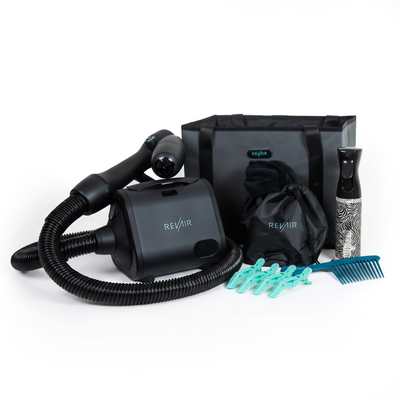
Low-tension drying, where hair is dried gently with controlled airflow and minimal manipulation, tends to preserve both moisture and curl definition better than high-heat methods. The RevAir Reverse-Air Dryer works this way, drawing hair down into the wand with reverse airflow so it dries root to tip without the friction of a traditional dryer or the wait of air drying. For wash days where time is the bottleneck, it's worth factoring your drying method into the overall routine plan.
Do Less on the Days You Have Less
A streamlined wash day isn't the same every time, and it doesn't have to be. The goal is having a baseline you can adjust, not a rigid checklist you fail when life gets in the way.
On a regular week, maybe you do the full wash, condition, and style. On a busier week, a co-wash and knowing how to keep your curls going between wash days can get you through without starting from zero.
Giving yourself permission to scale back without guilt is part of what makes a routine actually sustainable. The worst thing that can happen to a wash day routine is making it so demanding that you skip it entirely. Consistent, simpler wash days almost always produce better hair health outcomes than infrequent, elaborate ones.
The Simplest System That Works
If you want to start somewhere concrete, here's a framework:
Before wash day: Set out everything you need the night before - products, tools, clips, and a towel. Decision fatigue is lower when you're not tired and standing in a wet bathroom making choices.
During: Work in sections. It slows you down in the moment, but it speeds up drying and styling on the back end, and makes detangling significantly easier.
After: Do a quick mental note of what worked and what didn't while it's fresh. One small adjustment per wash day is how routines improve over time without becoming overwhelming.
Wash day doesn't have to be a whole thing. With a little structure and a shorter product lineup, most people can cut their wash day time significantly without sacrificing results.
Frequently Asked Questions
How do I know if my shampoo is too harsh?
If your scalp feels tight or your hair feels stripped after washing, that's a sign to switch formulas rather than adding more products to compensate. Look for gentle, sulfate-free shampoos or try a co-wash that cleans without over-drying your scalp.
Do I really need multiple creams, gels, and oils to get definition?
Usually, no. If you cleanse gently, detangle properly, and dry without friction, one lightweight leave-in or cream is often enough. Your technique does the heavy lifting, and layering products isn't required for good results.
What's the safest way to detangle to avoid breakage?
Detangle while your hair is wet with conditioner in, using a wide-tooth comb or a wet brush with flexible bristles. Start at the ends and work up, and don't rush. Tools designed to glide through wet hair without snagging, like the Wright Comb, help minimize tension and breakage.
Why does the drying method matter more than what I apply afterward?
Drying introduces either friction or control. Traditional blow-drying while brushing creates friction that leads to frizz and breakage. Methods that let you control heat and reduce friction, including air drying, diffusing, or a reverse-air dryer, remove water gently and keep hair cuticles smoother.
Will this streamlined routine work for my hair type and schedule?
Yes -- the principles are universal. Keep the four essentials: a gentle cleanse, a proper detangling tool, a low-friction drying method, and one styling product if you want it. With fewer decisions and tools that work with your texture, the routine is faster, more consistent, and easier to stick with.
Want to Go Deeper?
Washing Hair: The Best Wash Day Tips and Tricks for Natural Hair
Best Wash-and-Go Routines for Type 3 and Type 4 Natural Hair


