






The Low-Maintenance Hair Routine That Still Delivers Results
Low-maintenance has a reputation problem in natural hair care. The assumption is that if your routine isn't elaborate, if you're not spending hours on wash day, layering multiple products, or following a precise multi-step process, then you're not doing enough. You're cutting corners. Your results will show it.
That assumption is wrong.
Explore RevAir

A low-maintenance routine isn't a lazy routine. It's a focused one. It means you've identified what your hair actually needs and stopped spending time and energy on everything else. Done right, a simpler routine doesn't just match the results of a complex one. It often outperforms it, because consistency is easier to maintain when the process isn't exhausting.
What Low-Maintenance Actually Means
Low-maintenance doesn't mean skipping steps that matter. It means being honest about which steps actually matter for your hair and which ones you added because someone on the internet swore by them.
Every effective hair routine, regardless of how simple or elaborate, rests on the same foundation: a clean scalp, adequate moisture, minimal friction during handling, and a drying method that doesn't undo everything you just did. If those four things are covered, the rest is optional.
The goal of a low-maintenance routine is to cover that foundation reliably, in less time, with less decision-making. Not to see how much you can skip, but to see how little you actually need to get the results you want.
The Core Steps That Earn Their Place
A genuinely effective low-maintenance routine typically comes down to four steps, each with a clear job.
Cleanse. A gentle, sulfate-free shampoo or co-wash keeps the scalp clean without stripping the moisture your hair needs to behave well between wash days. How often you cleanse depends on your scalp, your activity level, and how much product you use, but the cleanse itself doesn't need to be complicated.
Condition. A good conditioner does two things: it restores moisture and provides slip for detangling. If you're conditioning properly, applying to wet hair, working through in sections, and giving it a few minutes to absorb, you may not need a separate detangling product at all.
Detangle with care. This step is less about what you use and more about how you do it. Wet hair, conditioner in, working from ends to roots with a wide-tooth comb or flexible brush. Rushing this step creates breakage that no product can fix after the fact. Taking an extra two minutes here saves significant time and frustration later.
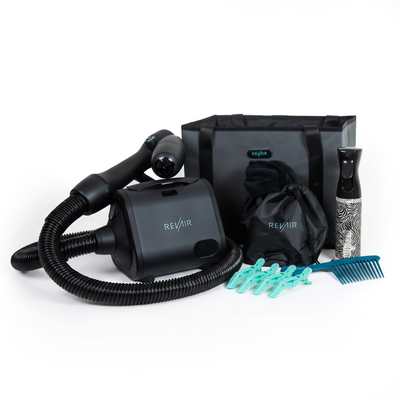
Dry with intention. Drying is where most routines either support or undermine everything that came before. High heat and friction create frizz and disrupt curl pattern. Air drying is gentler but slow, and can leave hair in an undefined state. The RevAir Reverse-Air Dryer handles drying and light stretching in one step using reverse airflow and low heat, which means less post-drying correction and a more predictable result each time. For anyone building a low-maintenance routine, having a reliable drying method is one of the highest-leverage decisions you can make.
What to Cut Without Guilt
If you're scaling back a more complex routine, it helps to know what's safe to remove. Most of the time, the first things to go are products that overlap with each other. The leave-in that does the same job as the conditioner you just used. The second styler applied on top of an already-working first one. The mid-week moisture spray your hair doesn't actually need if you're sealing properly on wash day.
Overnight treatments and weekly deep conditioning sessions can stay if your hair genuinely benefits from them, but for many people a good rinse-out conditioner used consistently does the job. The question to ask about every step is whether removing it would change your results in a meaningful way. If the honest answer is no, it's safe to let it go.
And if you're worried about the days between wash day, keeping curls refreshed and hydrated between washes doesn't require a complex refresh routine. A light mist and a bonnet overnight often does the work.
Why Simple Routines Produce Better Results Over Time
The argument for a low-maintenance routine isn't just about saving time. It's about what consistency does for hair health over months and years.
Hair responds to repeated, gentle care. Scalp health improves when it isn't regularly stripped and overloaded. Curl pattern becomes more defined and predictable when it isn't disrupted by excessive heat, tension, or product buildup. Moisture levels stabilize when the routine is consistent enough for your hair to stop overcompensating.
A complex routine done inconsistently, skipped when you're tired, rushed when you're busy, abandoned when life gets in the way, produces far worse outcomes than a simple routine done reliably. The best routine is the one you can actually repeat week after week without dreading it. If you're finding that hard to do, it may be worth revisiting the foundations of what makes a routine stick long term.
Building Yours
Start with the four core steps and nothing else. Give that baseline three to four consistent wash days before adding anything back in. If your hair feels dry after the conditioner step, address moisture first before adding a styler. If your curl definition is lacking, look at your drying method before reaching for a new product.
Add steps back one at a time, only when there's a clear gap the current routine isn't filling. That way every element in your routine is there because it's earning its place, not because you accumulated it gradually and never questioned it.
A low-maintenance routine that works is one of the best things you can build for your hair. Not because it's easy, but because it's sustainable, and sustainable is what creates results you can count on.
Want to Go Deeper?
The Rev Routine Explained: Why the Reverse-Air Dryer Is the Foundation
Curly Hair: The Best Time-Saving Tips to Simplify Your Daily Hair Regimen


