






Back-to-School Hair Routines: How to Simplify Without Sacrificing Results
The routine you built in July was designed for a July schedule. Slow mornings, flexible wash days, room to let hair air dry for three hours if it wanted to. Come late August, that same routine has to survive alarms, bus schedules, practice, homework, and the accumulated exhaustion of a full week, and it has to do it for more than one person at the same time. Most routines don't survive it. They get abandoned around week two and replaced with whatever is fastest, which is usually whatever is worst for hair, and the first one to go is almost always your own.
The fix is not discipline. It's building a system that assumes you'll be tired, short on time, and managing more than just your own head of hair, because you will be.
Explore RevAir

The Real Problem With School-Year Routines
Routines fail during the school year for one reason: they were designed for the best-case morning. A routine that requires twenty minutes per person works beautifully on the day everyone has twenty minutes and collapses entirely on the day you have seven minutes total, for everyone, including yourself.
A routine that survives the school year is built around the worst morning of the week, not the best one, and it's built around the full household, not just one person's hair. If it works on the day everyone overslept, and you're doing it solo, it works every day.
That means the question is not "what is the ideal routine" but "what is the shortest version of this routine that still protects everyone's hair, mine included?" Everything above that line is a bonus you do when you happen to have time.
The Three-Tier System
Build the routine in three tiers, and pick the tier that matches the morning you're actually having. This applies to your kids' hair and to yours. Your hair doesn't get a separate, lower-priority system just because you're the one running the morning.
- Tier 1 (three minutes each): Refresh, smooth, secure. No product beyond a light mist. This is the oversleep morning, for you and for them.
- Tier 2 (eight minutes each): Refresh, light leave-in on the ends, one intentional style. This is the normal weekday, and it's the tier most mornings should actually run on.
- Tier 3 (fifteen minutes each): Full restyle. Reserve for the day with margin, usually one weekday morning and the weekend.
The point of tiering is that nobody in the house, including you, has to decide whether to skip hair. You only have to decide which tier today is, and every tier is complete on its own terms.
Move the Work to the Night Before
The single highest-leverage change for a school-year routine is shifting effort from morning to evening, for the whole household at once. Morning time is expensive and unpredictable. Evening time is cheaper and more reliable, and it's the only place where you can realistically get to your own hair without it competing with everyone else's.
What belongs in the evening:
- Washing, conditioning, and drying, so hair is never wet at 6 AM
- Sectioning or setting for whatever style you want in the morning
- Securing hair with a bonnet or satin cover to reduce overnight friction
- Detangling, which is faster and gentler on hair that isn't rushed
What belongs in the morning:
- Refreshing and reshaping only
- One quick style per person
- Nothing that requires drying time, for anyone
Wet hair in the morning is the trap that breaks school-year routines, and it's worse with multiple people than it is with one. It forces high heat to catch up on time, or someone leaving the house with damp hair, and when you're the one managing several heads at once, that trap closes faster because there's no slack left in the schedule to absorb it. Moving wash day to evening removes the dilemma for everyone at once, including you.
Why Drying Time Is the Real Bottleneck
When people say they don't have time for hair, what they usually mean is they don't have time to dry it, and that math gets worse with every additional person going through the same bathroom in the same window. Everything else in a routine is measured in seconds. Drying is measured in blocks, and those blocks stack.
This is where the school year quietly does damage, to more than one person's hair at once. Faced with a time crunch, most people reach for maximum heat, because heat is the obvious lever. But high heat pushed through hair repeatedly does cumulative work on the cuticle, and cumulative is the key word. One high-heat session is survivable. A hundred and eighty of them across a school year, run through two or three heads of hair instead of one, is what people are describing in April when they say everyone's hair fell apart and they don't know why.
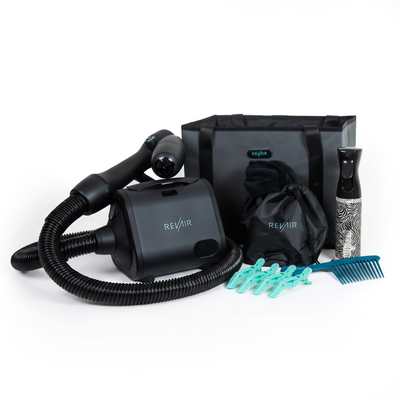
Drying with reverse air and tension changes the math. Because the airflow does the work of pulling hair straight and smooth rather than relying on temperature, you get a faster, more consistent dry without pushing the cuticle past what it can handle. The RevAir Reverse-Air Dryer is designed around this, and for a household running multiple heads through a school year, including yours, it's the change that compounds in your favor instead of against you.
If you're only going to fix one part of the school-year routine, fix drying. It's the step that determines whether the whole household's hair, yours included, ends the year better or worse than it started.
Cut the Product Lineup Before the Year Starts
Every product in the routine is a decision, and decisions are what slow mornings down, multiplied by however many people are getting ready. Before school starts, do a hard pass on the lineup for the whole house, including your own products, not just the kids'.
Keep:
- One cleanser
- One conditioner
- One leave-in or moisturizer
- One styler that works for the most common style, per person
Consider cutting:
- Anything bought for a specific style used twice a year
- Anything used less than three times since spring
- Duplicate products that do essentially the same job
- Anything that requires a second product to work properly
Streamlining wash day the same way is the other half of this. A shorter product lineup means a shorter wash day, for everyone, which means it actually happens on Sunday instead of getting pushed to a Tuesday nobody has time for, including you.
Build a Style Rotation Instead of Deciding Every Day
Deciding what to do with hair at 6:15 AM is a tax paid every single morning, and when you're deciding for multiple people plus yourself, it's a tax paid multiple times before anyone's even had breakfast. Remove it by building a rotation of three or four styles per person, yourself included, that can be executed without thinking.
A workable rotation covers different needs:
- One style that requires no heat and no restyling, for the fastest mornings
- One style that keeps hair off the face and neck, for practice or gym days
- One style that looks more finished, for days with something on the calendar
- One protective option that buys two or three days without restyling
This applies to you as much as it applies to your kids. If your own go-to style is still "figure it out in the moment," it's the least reliable part of the whole system and the first thing that gets cut when the morning runs long.
You don't need variety. You need reliability. A handful of styles you can do quickly will serve you better across a school year than a mental library of twenty you never actually attempt on a weekday.
The Sunday Reset
One block of time on the weekend does more for a school-year routine than any weekday effort, for the whole household at once. Use it for:
- Wash, deep condition, and dry, for everyone, including you
- A set or style that carries the week for each person
- Restocking whatever ran out
- A quick look at ends, scalp, and how the week treated everyone's hair
Ninety minutes on a Sunday buys five easy mornings for the entire house, not just the kids. That trade is almost always worth making, and it's the one place in the week where doing your own hair doesn't cost you anything else.
Common Questions
My kid wants to do their own hair now. How much should I let go?
Let go of the styling and hold onto the wash and dry. Styling is where independence builds confidence and mistakes are reversible. Cleansing frequency and drying method are where damage accumulates, so stay involved there until the habits are solid.
I'm managing hair for multiple kids plus myself. Where do I actually start?
Start with the tier system and apply it to the whole household at once, not one person at a time. Then move as much as possible to Sunday and weeknight evenings. The order that matters most is protecting your own routine from being the one that gets cut, since it's usually the first thing sacrificed when the morning runs short.
Is it bad to wear the same style every day?
Not inherently, but repeated tension in the same place is a real risk. If a style pulls, rotate where the tension sits. Same style, different part or different placement, is enough to prevent the wear pattern that causes thinning at the hairline.
How do I keep a style through sports and sweat, for multiple kids at once?
Secure it before activity rather than restyling after, for everyone. A style that's already contained handles sweat far better than one you're trying to rescue afterward. Rinse or refresh in the evening rather than adding product on top of dried sweat.
What if mornings don't have room for anyone's hair, including mine?
Then everything moves to evening and mornings become refresh only, for the whole house. That's a fully valid routine, not a compromise. Plenty of households run all their hair care at night and never touch it before school, parents included.


