






Winter Wash Day Upgrades: How to Adjust Your Routine When It's Cold
Wash day doesn't suddenly need a complete overhaul because the temperature drops.
But the routine that worked perfectly in August may need a few adjustments by November.
Explore RevAir

Cold outdoor air, dry indoor heat, hot showers, heavier fabrics, and spending more time indoors can all change how your hair feels and behaves. You may notice that moisture doesn't seem to last as long, your scalp feels different, or hair that normally feels soft after wash day starts feeling dry sooner.
The answer isn't necessarily more products.
Sometimes, it's just a smarter winter wash day.
1. Turn Down the Shower Temperature
A steaming shower feels especially good when it's cold outside, but your hair doesn't need the same temperature you do.
Very hot water can leave hair and scalp feeling drier, particularly if you're already dealing with seasonal dryness.
You don't have to suffer through a cold shower. Stick with comfortably warm water when cleansing and rinsing your hair instead of turning the temperature all the way up.
2. Pay Attention to How Often You're Cleansing
Winter doesn't automatically mean you should wash your hair less often.
Your scalp still needs to be cleansed based on buildup, oil, sweat, styling products, and your individual routine.
But if you've carried the exact same wash schedule from warmer months into winter and your hair suddenly feels consistently dry, it's worth reassessing.
Ask yourself:
- Does my scalp actually need cleansing today?
- Am I washing because my hair needs it or because it's wash day on the calendar
- Am I adding more product between washes and creating buildup?
- Does my hair feel dry immediately after washing or several days later?
Those answers can tell you more than an arbitrary wash-day rule.
3. Don't Confuse More Product With More Moisture
When hair starts feeling dry, it's tempting to pile on richer conditioners, oils, creams, butters, and leave-ins.
More isn't always the solution.
Heavy layering can eventually leave hair coated, weighed down, or harder for water and conditioning products to penetrate effectively.
Instead of automatically adding another product, pay attention to how your hair responds to the products you're already using.
Winter may call for a richer conditioner or a little more attention to moisture retention. It doesn't necessarily call for five extra steps.
4. Be Gentle While Your Hair Is Wet
Wet hair needs careful handling year-round, but winter dryness can make an already rough detangling routine feel even less forgiving.
Work in manageable sections, use enough slip, and avoid rushing through knots.
If your hair has become noticeably harder to detangle as the weather has changed, that's information. It may be telling you that your routine isn't maintaining moisture as well as it did during warmer months.
5. Don't Stay Wet for Hours Just Because You're Avoiding Heat
Avoiding excessive heat doesn't mean your hair needs to remain wet all afternoon.
For thick, dense, curly, coily, or low-porosity hair, air drying can take a long time, and that becomes considerably less appealing when it's 35 degrees outside.
Your drying method should make sense for both your hair and your life.
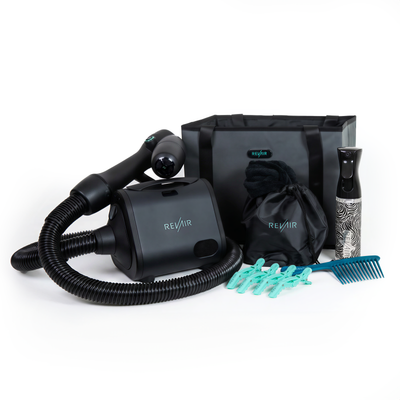
RevAir uses reverse-air suction and low heat to dry and stretch hair simultaneously, giving you an alternative to prolonged air drying or relying on higher-heat traditional drying methods.
The goal isn't to eliminate drying.
It's to be intentional about how you're drying.
6. Give Your Ends a Little More Attention
Your ends are the oldest part of your hair, and winter can be particularly unforgiving to them.
Scarves, sweaters, coats, hats, and high collars create additional opportunities for friction. Combine that with drier air, and ends can start feeling rough surprisingly quickly.
After wash day, pay attention to whether your ends feel as conditioned as the rest of your hair. You may need to adjust how you're applying your conditioner or leave-in rather than simply applying more product everywhere.
And if your ends are splitting, thinning, or repeatedly knotting, moisture alone may not solve the problem. Sometimes they need a trim.
7. Finish Wash Day With the Next Few Days in Mind
A good winter wash day shouldn't only make your hair look good that afternoon.
Think about how you're going to protect the results overnight, how much manipulation your style will require, and whether you'll need to completely restyle it tomorrow.
A satin bonnet, scarf, or pillowcase can help reduce overnight friction. Choosing styles that don't require daily heat or extensive manipulation can also help you get more mileage from the work you already did.
The easier it is to maintain your results, the less likely you are to keep starting over.
Your Winter Routine Doesn't Need to Be Complicated
Winter hair care can quickly turn into a pile of products and an increasingly long list of rules.
It doesn't have to.
Start with the basics:
Cleanse when needed. Condition thoroughly. Detangle gently. Dry intentionally. Protect your ends. Preserve your results.
Then adjust based on what your hair is actually telling you.
The best winter wash day isn't the one with the most steps.
It's the one that leaves your hair ready for the days ahead.


