






How to Prep Your Hair for Fall Without Overhauling Your Routine
Most people wait until their hair tells them something is wrong before they change anything. The first week of static, the first time a wash day that used to last five days only lasts three, the sudden reappearance of split ends that seemed handled a month ago. By then you're reacting instead of adjusting, and reacting almost always costs more effort than adjusting would have.
The shift from summer to fall is one of the easiest seasonal transitions to get ahead of, because the change is predictable. You know it's coming. Here's what actually changes, and the small number of adjustments worth making before it does.
Explore RevAir

What Actually Changes When the Season Turns
The temperature drop gets all the attention, but temperature is not what your hair responds to most. Moisture in the air is.
Through summer, dew points stay high. The air holds a lot of water, and your hair is in constant exchange with it. That's why summer frizz happens: your strands are absorbing moisture from the environment and swelling. Fall reverses the equation. Dew points fall, the air holds less water, and the exchange runs the other direction. Your hair gives moisture up to the air instead of pulling it in.
Then indoor heating starts, which is the part people underestimate. Running a furnace can drop indoor relative humidity into the twenties or lower, which is drier than most desert climates. You may be spending sixteen hours a day in air that pulls moisture out of your hair continuously.
The result is a specific and recognizable set of changes:
- Static that wasn't there in July
- Styles that hold their shape but lose their softness
- Ends that feel rougher even though nothing about your routine changed
- Faster color fade if your hair is color treated
- More tangling, especially at the nape and around the crown
The 5-Minute Fall Audit
Before you buy anything or change anything, spend five minutes assessing where your hair actually is right now.
- Run your fingers down a section from mid-length to ends. Rough or catchy means cuticle disruption, likely from summer sun, chlorine, or salt.
- Check how long your last style held. If it's shortening, moisture retention is the issue, not your styling technique.
- Look at your ends in good light. Summer damage that you tolerated in a bun becomes obvious when hair is worn down more often.
- Note how your scalp feels 48 hours after washing. Tight or itchy points to a drying cleanse that fall air will amplify.
- Count your product steps. If you're above five, the transition is a good excuse to cut, not add.
Adjust How You Dry Before You Adjust What You Apply
This is the part that gets reversed most often. When hair starts feeling drier, the instinct is to layer on more product. But the drying step determines how much of anything you apply actually stays where it belongs.
High heat dries hair from the outside in, which forces water out of the cortex quickly and leaves the cuticle lifted. A lifted cuticle in humid summer air is why frizz shows up differently depending on your texture. That same lifted cuticle in dry fall air causes moisture loss instead, and no amount of leave-in conditioner compensates for a cuticle that won't lie flat.
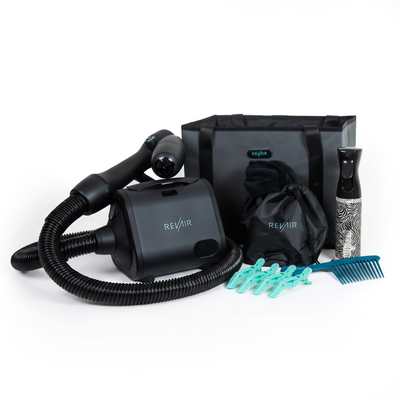
Drying with reverse air and tension, rather than high heat and manipulation, does two things that matter specifically in fall. It smooths the cuticle in the direction it naturally lies and removes water without stripping the internal moisture your hair needs to hold onto during a dry season. The RevAir Reverse-Air Dryer is built around exactly this, which is why the drying step is the single highest-return change you can make heading into fall.
If you change one thing this season, change that. Everything else on this list is refinement.
Why Moisture Loss Happens Faster Than You Notice
Hair is not a sealed system. The cuticle is a layer of overlapping scales, and how tightly those scales sit determines how much water moves in and out of the cortex underneath.
Through a humid summer, hair sitting in high-moisture air stays relatively plump even when the cuticle is compromised, because the environment keeps resupplying what's lost. Damage accumulates without announcing itself. Chlorine, salt water, and UV exposure all disrupt the cuticle over the course of a season, and high ambient humidity masks the effect.
When dew points drop, the mask comes off. Hair that was already porous now loses water faster than it can recover it, and the signals that damage is already underway become impossible to ignore in September. This is why fall dryness often feels like it appeared overnight. It didn't. It was accumulating for three months and simply became visible when the environment stopped compensating.
The practical takeaway: the work you do in August determines how your hair behaves in November. Addressing summer damage now, before dry air amplifies it, is far less work than repairing it later.
What to Change and What to Leave Alone
Worth changing:
- Move your deep conditioning from occasional to scheduled, roughly every other wash
- Add a sealing step at the ends after styling, where moisture loss is fastest
- Lower your drying heat, or move to a tension-based drying method entirely
- Switch to a satin or silk pillowcase if you haven't, since friction damage compounds in dry air
- Trim visible summer damage rather than trying to condition it away
Leave alone:
- Your wash frequency, at least at first. Change one variable at a time so you know what worked.
- Your entire product lineup. Seasonal change does not require a new shelf.
- Your protective styling schedule, unless it stopped working for other reasons.
A Simple Four-Week Transition
- Week one: Clarify once to remove accumulated summer buildup, then deep condition.
- Week two: Trim ends. Assess how hair feels post-trim before adding anything new.
- Week three: Adjust your drying method. Notice how long the style holds compared to your summer baseline.
- Week four: Add a sealing step only if you still see moisture loss at the ends.
Four weeks, four changes, and you enter the driest part of the year with your hair already adapted instead of catching up.
Common Questions
When should I actually start transitioning my routine?
Mid to late August in most of the country. You want the adjustments in place before indoor heating starts, not after. If you wait for the first dry spell, you're already behind.
My hair feels fine right now. Do I still need to change anything?
Feeling fine in August is not a reliable signal, because summer humidity compensates for a lot. Run the five-minute audit above. If your ends feel rough or your styles are holding for less time than they did in June, the underlying change is already happening.
Should I use heavier products in fall?
Not necessarily heavier, but more consistent. A lightweight product used at every wash outperforms a heavy product used occasionally, and heavy products on fine or low porosity hair tend to sit on the surface rather than absorb.
Is static a sign of damage?
Not on its own. Static is an electrical charge issue caused by dry air, and even perfectly healthy hair gets it. That said, damaged hair holds less moisture, and drier hair generates more static. Persistent static alongside rough ends is worth paying attention to.
Do I need a trim before fall or can it wait?
If you spent time in pools, salt water, or direct sun, get it done before the air dries out. Damaged ends lose moisture faster than healthy ones, so leaving them in place means the whole length works harder through a dry season.
Keep Learning
How to Build a Deep Cleansing Routine That Actually Resets Your Hair
Why Consistency Beats Perfection When You're Building a Routine


